Homeowner Guides
Wildfire Smoke and Your Heat Pump: What Filtration Actually Does During a BC Air Quality Warning
A heat pump keeps you cool with the windows shut — but only a filter removes smoke. Here's how ducted and ductless systems differ during a BC air quality warning, and what to specify before you sign.
Published 2026-07-30 · Updated 2026-07-30 · Retrofit Network
Planning estimate only — pricing is not guaranteed. Displayed amounts are approximate, not contractor quotes, bids or offers. Actual costs may fall outside the range. A contractor must assess your property and provide an official written estimate or quote before you agree to proceed. The contractor’s written terms govern pricing, inclusions, exclusions and changes. Retrofit Network does not guarantee costs, rebate eligibility, rebate payments or energy savings.
Why this matters more every summer
Air quality warnings for wildfire smoke have become a routine part of the BC summer rather than an exception. Through July 2026, the Province and Environment Canada issued repeated wildfire smoke warnings across the South Coast and the Interior, with Okanagan regions cycling between warning levels as smoke moved through. The same plumes regularly cross into Alberta.
For homeowners partway through a heat pump retrofit decision, this changes the question being asked. It used to be about heating cost. Increasingly it is also about whether the house can stay closed up and comfortable for a week in August. Those are related but separate problems, and the equipment that solves them is not the same equipment.
The honest split: cooling is the heat pump's job, filtration is the filter's job
A heat pump moves heat. In summer it moves heat out of your house, which is what lets you keep every window shut during an advisory instead of cross-ventilating at night the way most older BC homes were designed to. That is a genuine and underrated benefit during smoke season, and it is the honest version of the claim.
What a heat pump does not do is remove particles. Wildfire smoke's health risk is fine particulate matter under 2.5 microns, small enough to travel deep into the lungs and, at high concentrations, cross into the bloodstream. Removing it requires media that physically captures it. If a sales conversation blurs cooling and air cleaning into one benefit, ask which component is doing the filtering.
Ducted systems: this is where you can actually filter
A ducted heat pump moves the whole home's air through a single filter location, which makes it the best filtration opportunity in the house. The rating scale is MERV, and the number that matters for smoke is MERV 13 — it captures roughly 90% of particles in the 0.3 to 1.0 micron range, which is exactly where smoke PM2.5 sits. It is the minimum the U.S. EPA recommends during smoke events.
The catch is static pressure. A high-efficiency filter squeezed into a one-inch slot restricts airflow, and restricted airflow hurts both comfort and equipment life. The fix is surface area: a four- or five-inch media cabinet filters harder while restricting less, and lasts far longer between changes. Specify the cabinet during the retrofit, when the ductwork is already open and the cost is incremental — retrofitting one later is a separate job.
One operating habit is worth as much as the hardware. During an advisory, set the fan to continuous rather than auto. A filter only works when air is moving through it, and a well-sized heat pump in mild smoky weather may barely run. The EPA has found that a higher-efficiency filter combined with continuous fan operation can cut indoor PM2.5 by roughly half during a smoke event.
Ductless mini-splits: plan for portable HEPA instead
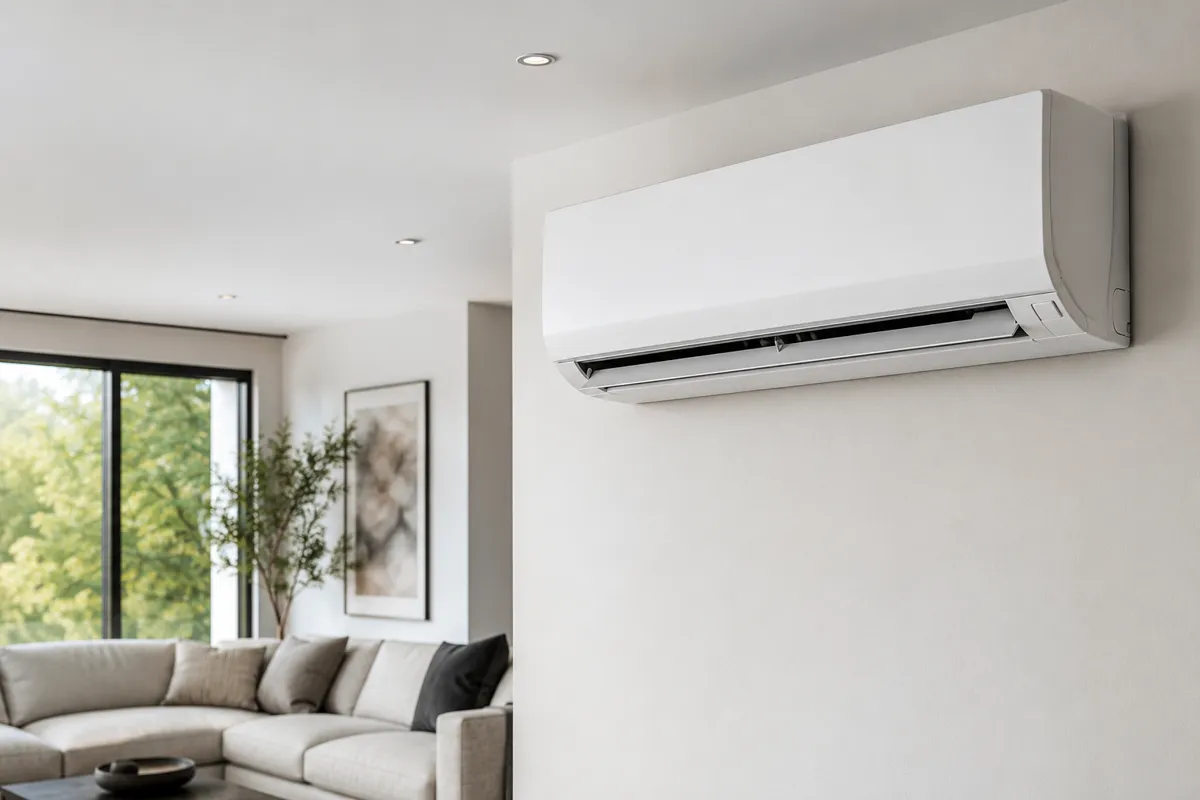
Ductless heads are excellent at heating and cooling and are the right answer for a great many BC homes, especially older ones without existing ductwork. But their filters are thin washable mesh screens whose job is protecting the indoor coil from lint and hair. They are not particulate filters and there is no MERV 13 equivalent for a typical wall head.
This is not a reason to avoid ductless. It is a reason to budget separately. A portable HEPA unit sized to the room, running continuously in the bedroom with the door closed, does more for your exposure than anything you can add to a mini-split head. Match the unit's clean air delivery rate to the room's floor area, and avoid any device marketed on ozone or 'activated oxygen' — ozone is a lung irritant.
Clean the mini-split screens more often during smoke season regardless. They load faster in smoky conditions, and a clogged screen costs you capacity and efficiency even though it was never protecting your lungs.
HRVs and ventilation during an advisory
Newer and deep-retrofitted BC homes are tight enough to need mechanical ventilation, usually an HRV. During a smoke event that system is working against you, because its entire purpose is bringing outdoor air inside, and stock HRV filters are not smoke filters.
The right move is to reduce, not eliminate. Drop the HRV to its lowest scheduled setting, or use recirculation or standby mode if the unit has one. Some units accept a higher-grade cartridge on the supply side, which lets you keep ventilating at a reduced rate — worth asking your installer about before smoke season rather than during it. Once the plume clears, run the system back up and flush the house; a week of no ventilation in a tight home stacks up carbon dioxide, humidity and odours.
The same logic applies to range hoods and bathroom fans. Running them hard depressurizes the house and pulls unfiltered outdoor air in through every gap in the envelope. Use them for what they are for, then shut them off.
What to ask before you sign a retrofit quote
Filtration is cheap to include and expensive to add later, so it belongs in the quote conversation rather than a follow-up call. Five questions worth asking in writing: What filter depth does this system accommodate, and can it take a four- or five-inch media cabinet? What is the measured static pressure with the filter you are proposing? Does the thermostat support a continuous fan mode? If we have an HRV, does it accept a higher-grade supply-side filter cartridge? And what does a replacement filter cost, since I will be buying several a year now rather than two?
Also ask how the system will be commissioned. Airflow and static pressure measurements taken at startup are what tell you whether the filter you chose is actually compatible with the blower you bought. A contractor who measures is a contractor who can be held to a number.
The realistic smoke-season setup
For a ducted home: a MERV 13 in a properly sized media cabinet, fan set to continuous during advisories, filters checked every two to four weeks while smoke is active, HRV turned down, windows closed.
For a ductless home: the same window and ventilation discipline, plus a portable HEPA unit in the bedroom and any room where someone with asthma or a heart condition spends the day. Spend the money on the rooms that matter rather than trying to treat the whole house with equipment that cannot do it.
In both cases the heat pump earns its keep by making 'keep the windows shut' a livable instruction rather than a miserable one. That is a real benefit. It is just not the same as air cleaning, and a good contractor will tell you so.
FAQ
Does a heat pump filter wildfire smoke?
Not by itself. A ducted heat pump can carry a MERV 13 filter that captures smoke particulate, so the filter does the work, not the heat pump. A ductless mini-split's washable screen is not a smoke filter. The heat pump's real contribution is letting you keep windows closed without overheating.
Will a MERV 13 filter damage my heat pump?
Not if it is sized properly. The risk comes from cramming a high-efficiency filter into a thin one-inch slot, which raises static pressure and starves the blower. A four- or five-inch media cabinet has far more surface area, so it filters more while restricting less. Ask your installer to measure static pressure at commissioning.
Should I turn off my HRV when there is an air quality warning?
Turn it down rather than off. Use the lowest scheduled setting, or recirculation or standby mode if your unit has one. Leaving it off for a week in a tight home means carbon dioxide, humidity and odours build up. Run it back up and flush the house once the smoke clears.
Can I add filtration to a ductless mini-split?
Not meaningfully. Wall heads are built around thin washable screens and there is no MERV 13 equivalent. Budget for portable HEPA units in the rooms that matter instead, and clean the mini-split screens more often during smoke season so the system keeps its capacity.
How often should I change filters during smoke season?
Every two to four weeks while smoke is active, versus the usual three to six months. Pull the filter and look at it — grey media and weak airflow at the registers mean it is loaded. A loaded filter chokes the blower as well as filtering less.
Sources to verify
Get matched with local installers
Tell us about your home and project, and compare quotes from local retrofit contractors — free for homeowners, no obligation.